
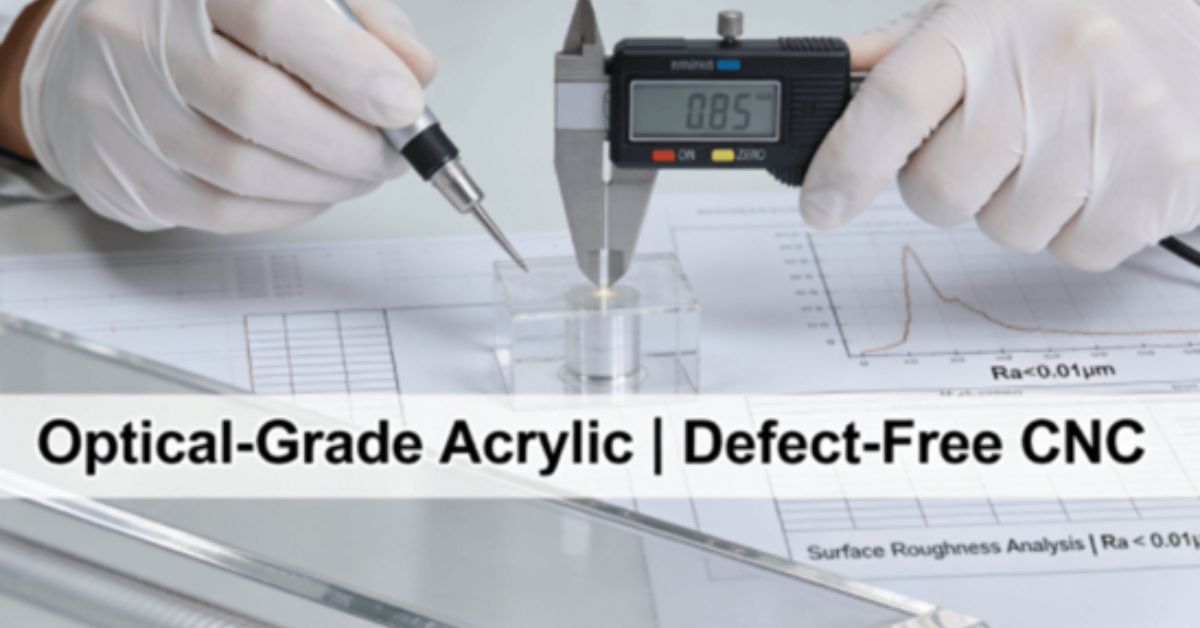
From Concept to Crystal Clarity: Mastering Acrylic CNC Machining to Avoid Costly Defects in High-Value Designs
Designers and engineers leveraging acrylic (PMMA) for its exceptional transparency, lightweight nature, and formability often encounter post-machining defects like micro-cracks, hazy white edges, surface scratches, or warping. These flaws lead to scrapped prototypes, project delays, and products that fail to meet optical or structural standards, incurring up to 30% in extra costs and significant brand risk.
The root cause is treating acrylic like a “common plastic” and applying strategies meant for metals or other engineering plastics, ignoring PMMA’s unique thermal sensitivity, inherent brittleness, and high susceptibility to internal stress. This article delves into the material science of acrylic CNC machining, providing a systematic methodology covering specialized tooling, precise thermal management, and innovative fixturing. The goal is to empower creators to eliminate these defects at their source and achieve optical-grade surface quality.
What Makes Acrylic a Uniquely Challenging Material for Precision CNC Machining?
Acrylic’s fundamental properties — its amorphous polymer structure, brittle fracture mechanism, and low glass transition temperature — demand a fundamentally different machining approach than metals or common plastics.
1. Molecular Structure and Thermal Vulnerability
Unlike crystalline metals, acrylic is an amorphous polymer with randomly arranged molecular chains, contributing to its brittleness. Crucially, its low glass transition temperature (Tg) of about 105°C makes it highly susceptible to thermal damage. Machining heat can quickly soften the material, causing surface melting and internal stress that lead to cracking and haze, requiring a paradigm shift in process control.
2. Brittle Fracture vs. Plastic Deformation
The material removal mechanism for acrylic is brittle fracture, not the plastic deformation seen in metals. As detailed in resources like the ASM Handbook on polymer properties, this requires fundamentally different tool geometries and cutting strategies. Excessive force can initiate micro-cracks, while insufficient control leads to poor surface finish and chipping, making precise parameter selection non-negotiable.
3. The Demand for Specialized Process Design
Successful acrylic CNC machining necessitates a dedicated process framework. It requires tools with large rake angles (often >10°) for clean shearing, meticulously controlled cutting parameters (e.g., spindle speeds around 200-400 m/min), and unique cooling strategies. Managing clamping stress and cutting forces is paramount to prevent distortion and delayed cracking, blending precision engineering with deep materials science understanding.
How Can “White Edge” and Cracking Defects Be Eliminated at the Source?
Eliminating “white edge” and cracking requires addressing their root causes: thermal damage and mechanical stress concentration, through specialized tooling, optimized parameters, and intelligent process design.
1. Combating Thermal Damage: The “White Edge” Phenomenon
The hazy “white edge” is a thermal defect caused when cutting temperatures exceed PMMA’s Tg, inducing micro-melting and fractures. Eliminating it requires a holistic thermal management strategy. This includes using polished, single-flute tools to reduce friction, implementing high-speed, low-feed-rate strategies to minimize heat per cut, and employing pulsed air or mist cooling to keep the cutting zone temperature stably below 75°C, preventing localized overheating.
2. Mitigating Mechanical Stress: Preventing Cracks
Cracking occurs when localized tensile stress exceeds the material’s strength. Prevention focuses on stress distribution and minimization. This is achieved through progressive step-cutting (light, layered passes) to reduce cutting forces and innovative fixturing using custom soft jaws or vacuum chucks that distribute clamping pressure evenly. Finite element analysis (FEA) can optimize fixture design to eliminate stress concentrations that lead to fracture.
3. A Systematic Defect Prevention Framework
Ultimately, defect elimination is not about a single trick but a systematic process framework. This integrates material-specific tool libraries, parameter databases for different PMMA grades, and real-time monitoring. For a comprehensive guide covering the full technical framework from material selection to post-processing, this in-depth resource on acrylic CNC machining provides valuable insights.
What Does It Truly Take to Achieve “Optical Grade” Surface Finishes on Machined Acrylic?
Achieving optical-grade surfaces (Ra < 0.01μm, >92% transmittance) requires a multi-faceted technological approach, from nanoscale tooling and vibration control to advanced multi-axis finishing and sub-micron polishing.
- Defining and Quantifying “Optical Grade”: True optical-grade quality is measurable. Key benchmarks include a surface roughness (Ra) below 0.01μm, achieving a mirror-like finish, and light transmittance exceeding 92% with minimal haze. These quantifiable metrics are essential for lenses, light guides, and display components where any imperfection directly impacts performance.
- The Five Technological Pillars: Reaching these standards rests on five interconnected pillars: 1) Diamond tooling with nano-coatings for micron-level precision; 2) Micro-vibration control systems to constrain machining vibration; 3) Closed-loop thermal management to maintain a stable cutting environment; 4) 5-axis simultaneous machining to eliminate witness lines on complex curves; and 5) Advanced polishing techniques like magnetorheological finishing to achieve a final Ra as low as 0.001μm.
- The Path from Machining to Polishing: The journey doesn’t end at the machine. A seamless transition to precision post-processing is critical. This involves a staged process from machining with optimized parameters directly to fine polishing with micron-grade compounds, avoiding intermediate contamination. The result is crystal-clear parts with clarity and surface quality that rival or exceed that of cast acrylic sheet.
When Should You Choose CNC Machining Over Laser Cutting for Acrylic Parts?
The choice between CNC machining and laser cutting hinges on application requirements: CNC excels in 3D complexity, optical edge quality, and structural integrity, while laser cutting is superior for fast, 2D profiling.
1. Fundamental Process Differences: Mechanical vs. Thermal
The core difference lies in physics: CNC machining is a mechanical, subtractive process, while laser cutting uses thermal ablation. For acrylic, laser cutting often creates a carbonized heat-affected zone (HAZ) at the cut edge, which can reduce light transmittance by 15-30% and introduce internal stress, compromising optical and mechanical properties.
2. CNC Machining: Superior for 3D and Performance-Critical Parts
For components requiring three-dimensional geometry, superior edge clarity, and full structural strength, CNC machining is the clear choice. It produces complex 3D contours, undercuts, and precise features with edges that retain the material’s original properties, making it ideal for functional prototypes, optical lenses, and load-bearing assemblies.
3. Laser Cutting: Efficiency in 2D Applications
Laser cutting excels at high-speed 2D profiling and batch production of flat parts with intricate outlines. It is highly efficient where ultimate edge optical quality is not the primary concern. The decision matrix is clear: for performance-critical, three-dimensional, or optically perfect parts, CNC is indispensable. For rapid, cost-effective 2D part production, laser is suitable.
How Do Quality Certifications Translate to Tangible Reliability in Acrylic Part Production?
Certifications like ISO 9001 and AS9100D represent more than paperwork; they embody a system for traceable, consistent process control and defect prevention, ensuring batch-to-batch reliability for high-stakes applications.
1. ISO 9001: The Framework for Consistent Processes
Certifications like ISO 9001:2015 represent a systematic quality management framework. For acrylic machining, this translates to documented procedures for every critical parameter — tool selection, speeds/feeds, cooling, and inspection. This ensures full traceability and process repeatability, meaning any deviation can be traced back to its specific production batch.
2. Industry-Specific Rigor: IATF 16949 and AS9100D
For automotive, aerospace, or medical applications, standards like IATF 16949 and AS9100D impose even stricter process control and risk management. They mandate advanced quality planning, strict control of production part approval, and robust corrective action systems. A certified supplier has proven methodologies to proactively prevent defects and ensure batch-to-batch consistency under regulatory scrutiny.
3. From Certificate to Verifiable Evidence
The tangible outcome is quantifiable reliability. A certified manufacturer provides supporting data: material certifications, first-article inspection reports, statistical process control charts, and dimensional inspection reports from equipment like CMMs. This data-driven approach transforms abstract claims into verifiable, objective evidence of manufacturing excellence. As outlined in the ISO 9001 framework, such systematic controls are fundamental to delivering consistent quality.
What Are the Critical Questions to Ask When Selecting a Partner for High-Stakes Acrylic Projects?
Selecting the right partner requires evaluating their depth in materials science, proprietary process innovation, and advanced quality verification capabilities to ensure they can deliver optical-grade, reliable parts.
- Depth of Materials Science Expertise: Probe their material-specific knowledge. Can they provide detailed property data for different PMMA grades (molecular weight, Tg, CTE)? Do they offer guidance on material selection based on application (e.g., UV-stable for outdoor use, medical-grade for biocompatibility)? Their expertise must extend beyond machining into the material’s intrinsic behavior.
- Proprietary Process Innovation: Assess their technical innovation capability. Do they have patented solutions or proprietary technologies specifically for challenges like white edges or stress cracking? Inquire about their thermal management strategy — can they detail their cooling approach and temperature control precision? A leader will have developed specialized tool libraries and parameter sets for acrylic.
- Advanced Quality Verification Infrastructure: Scrutinize their quality assurance capabilities. Do they possess in-house optical metrology like white light interferometers or spectrophotometers to provide quantifiable reports on surface roughness (Ra) and light transmittance? Is their quality system digital and traceable? Request sample inspection reports to verify their claims. Therefore, for projects demanding both optical performance and structural reliability, partnering with an experienced CNC machining precision supplier is crucial.
Conclusion
Acrylic CNC machining is a specialized discipline synthesizing materials science, thermodynamics, and precision engineering. By moving beyond generic processes and adopting a systematic methodology tailored to its unique properties, designers and manufacturers can definitively overcome defect-related challenges. This unlocks acrylic’s full aesthetic and functional potential, enabling the creation of truly differentiated, high-value products.
Also Read: Chief Technical Examiner: The Powerful Role
FAQs
Q: What is the main difference between machining acrylic and machining polycarbonate?
A: The key difference is material behavior. Acrylic is more brittle and prone to cracking under stress, requiring sharper tools and careful stress management. Polycarbonate is tougher and impact-resistant but can gum tools if not cooled properly. Acrylic offers superior optical clarity.
Q: Can acrylic CNC machined parts achieve a finish as clear as cast acrylic sheet?
A: Yes, with advanced machining and polishing, optical clarity rivaling cast sheet is achievable. This involves diamond tools, multi-axis finishing passes, and subsequent precision polishing, all while strictly controlling heat and vibration to prevent sub-surface haze.
Q: How do you prevent tool marks and visible machining lines on transparent acrylic?
A: Prevention requires a multi-pronged approach: using razor-sharp, geometry-optimized tools; employing high spindle speeds with low feed rates for finishing; implementing climb milling; and using raster angle offsets. Post-process polishing then removes any residual microscopic lines.
Q: What are the size limitations for CNC machining acrylic parts?
A: Size limits are set by the CNC machine’s work envelope. Industrial 5-axis mills can handle blocks measuring several feet. For very large panels, precision joining of machined sections may be used. Maintaining precision typically has a practical limit around 2-3 meters.
Q: Is stress-relieving necessary for acrylic parts after CNC machining?
A: Often, yes. Machining can induce internal stresses, risking delayed cracking or crazing, especially under thermal or chemical exposure. Annealing at a temperature just below the glass transition temperature (e.g., 70-80°C) allows these stresses to relax, improving long-term stability.