
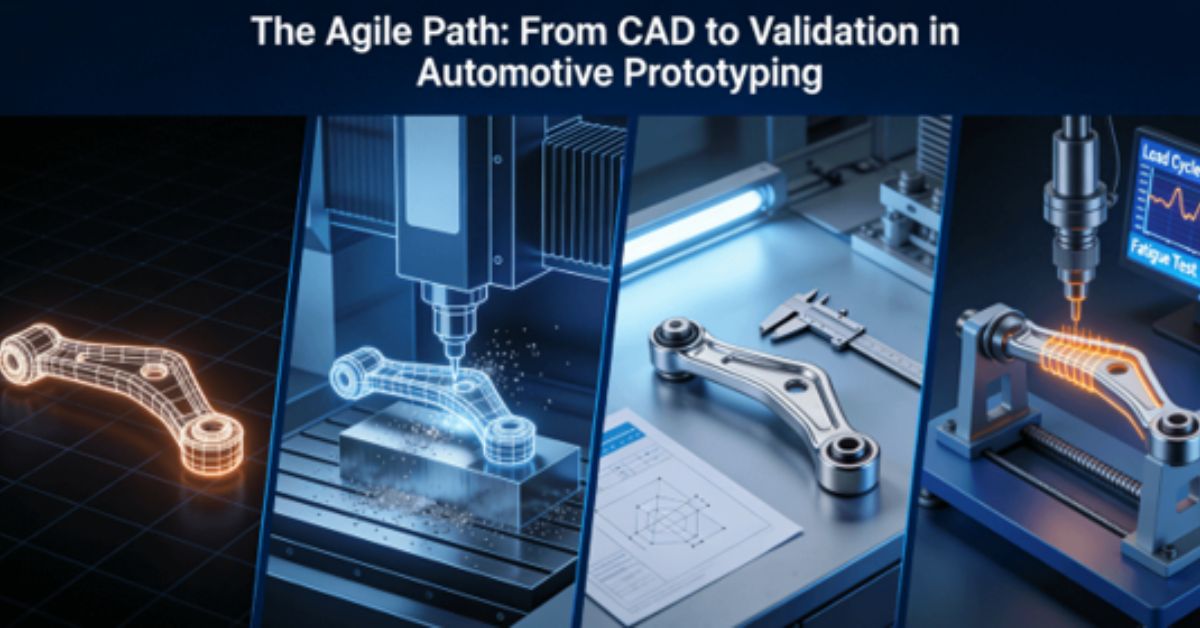
How to shorten the automotive prototype development cycle by 60% and reduce costs by 40%
The automotive industry is currently facing a profound challenge: a surge in demand for personalized and low-volume production. Traditional mold-based manufacturing methods, with their lengthy cycles and high costs, have become a bottleneck hindering innovation speed and market responsiveness, especially in the fields of new energy vehicles and high-end customization. The root of this dilemma lies in the fundamental contradiction between the traditional mass production model and the market’s demand for “low-volume, high-customization.” Development processes reliant on tooling involve not only massive upfront investment but also make design iterations painfully inflexible.
This article delves into how rapid prototyping automotive serves as a key solution, providing a clear path for efficient and economical low-volume automotive component development by analyzing technology selection, material considerations, and how to choose professional prototyping services.
Why is the Automotive Industry Urgently Shifting to Rapid Prototyping to Address Low-Volume Production?
In today’s pursuit of personalization and rapid iteration, the economic drawbacks of traditional mold manufacturing in low-volume scenarios are increasingly apparent. Developing a set of traditional injection or die-casting molds for mass production typically requires an upfront investment of hundreds of thousands to millions and a delivery cycle spanning several months. For custom parts, concept validation, or market testing requiring only hundreds or even dozens of units, the cost and risk become prohibitively high.
Market data clearly points the direction. According to reports from Verified Market Research, the global automotive prototyping market is showing significant growth, driven by the industry’s urgent need for agile development. Here, rapid prototyping in automotive industry emerges as an economic inflection point solution for low-volume production through its core advantages of being mold-less and charged per part. It allows companies to manufacture single or small quantities of parts with minimal initial cost, enabling rapid design validation, functional testing, or user feedback collection.
The core value of this shift lies in accelerating time-to-market and reducing trial-and-error costs. As emphasized by SAE International in related research, agile development and rapid iteration have become crucial for maintaining competitiveness in the modern automotive industry. In this process, Precision CNC machining plays an indispensable role. It can directly machine functional components with extremely high dimensional accuracy and excellent mechanical properties from non-heat-treated metal or engineering plastic blanks, perfectly meeting the stringent requirements for performance and reliability of prototypes for critical areas like power train and chassis structures.
How to Choose the Right Prototype Materials and Processes for Concept Validation vs. Functional Testing?
Prototype manufacturing is not a “one-size-fits-all” endeavor. Selecting the appropriate materials and processes based on different testing purposes is the first step to ensuring development efficiency and test validity. The core considerations when choosing prototype materials include: mechanical properties (strength, stiffness), thermal properties, chemical stability, cost, and post-processing requirements.
Strategic Material Selection Based on Testing Objectives
Prototype testing can be broadly categorized into concept validation, fit-check, functional testing, and durability testing. For conceptual models that only need to verify appearance, dimensions, or simple assembly, economical materials like ABS or ABS-like resins are ideal. When a prototype needs to simulate the structural performance of the final product, the material’s mechanical properties must be prioritized.
Applicable Scenarios for Key Manufacturing Processes
- For Complex Metal Functional Parts: 5-axis CNC service
When a component features complex surfaces, deep cavities, or irregular geometries and needs to be made from materials like aluminum alloy, stainless steel, or even titanium to withstand high loads, a 5-axis CNC service is the preferred choice. Through multi-axis simultaneous machining, it can manufacture complex geometries in a single setup, ensuring extremely high precision and surface quality. This makes it highly suitable for prototypes of critical components like engine brackets or turbo housings.
- For Complex Internal Cavities and Non-Load-Bearing Structures: 3D Printing (e.g., SLS)
Additive manufacturing technologies like Selective Laser Sintering (SLS) excel at producing parts with complex internal channels, lightweight lattice structures, and offer great design freedom without the need for supports. It is often used for concept validation of parts like intake manifolds or cooling ducts that require functional airflow but not extreme absolute strength.
- For Low-Volume Appearance Parts: Vacuum Casting
When producing dozens of high-surface-quality appearance parts for display or user research, vacuum casting can replicate products almost identical to the CNC master mold at a relatively low cost.
The Cornerstone of Functional Testing: Rapid Prototype Machining
For rigorous functional tests such as crash simulation, fatigue testing, or validation in high-temperature and high-pressure environments, rapid prototype machining is irreplaceable for metal prototypes. It can quickly deliver samples with material properties highly consistent with production parts, providing a reliable and realistic data foundation for testing. For instance, test data from a suspension link prototype machined from 7075 aluminum via CNC carries far more significance for guiding production design than data from a plastic model. For more in-depth standards on material selection, one can refer to the authoritative series of testing standards for engineering plastics and metals published by the American Society for Testing and Materials (ASTM). For a comprehensive understanding of rapid prototyping automotive solutions, you can read a more in-depth blog article on the topic.
How Do Professional Product Prototyping Services Integrate Processes to Compress Development Cycles?
When selecting product prototyping services, the key is to distinguish between a supplier and a partner. Fragmented services (e.g., Company A for design, Company B for machining, Company C for post-processing) lead to soaring communication costs, information distortion, and uncontrollable timelines. In contrast, an integrated professional service provider becomes an extension of the development team by consolidating the entire workflow from design to delivery.
Its core value lies in the “rapid iteration loop” formed through efficient internal collaboration. Starting from receiving the customer’s CAD model, a professional service team immediately initiates a Design for Manufacturability (DFM) review, providing optimization suggestions to prevent potential issues. Engineering optimization and CNC programming are seamlessly connected internally, and manufacturing and post-processing (e.g., sandblasting, anodizing, painting) are conducted under the same quality control system. This integrated model can compress the “design modification – programming – machining – delivery” iteration cycle from weeks down to a few days, thereby reducing the overall development time for custom components by over 50%.
Behind this efficiency and quality lies systematic capability. Choosing a service provider with authoritative certifications such as IATF 16949 (Automotive Quality Management System) and AS9100D (Aerospace Quality Management System) is crucial. These certifications are not only strong proof of their process standardization and traceability but also represent their capability to meet the stringent quality requirements of the automotive industry, ensuring reliable, high-quality delivery.
How Does an Online Instant Quoting System Enhance the Efficiency and Controllability of Prototype Development?
In fast-paced product development, time is money. The traditional quoting model relies on repeated email communication, technical evaluation, and commercial negotiation. A simple inquiry can take several days, severely delaying project initiation. The advent of Online instant quoting systems has fundamentally changed this landscape.
Through an intelligent online platform, users simply upload the 3D CAD file of the part (e.g., in STEP or IGES format). The system, based on advanced geometric analysis and a manufacturing knowledge database, can automatically generate a detailed quote within minutes. This process is not only instant but also transparent. The system analyzes the part’s manufacturability in real-time, identifies potential challenges (e.g., thin walls, deep holes), and provides preliminary DFM feedback. It also clearly itemizes cost breakdowns, material options, and estimated lead times.
This grants engineers and procurement personnel unprecedented foresight and initiative. In the early stages of a project, teams can conduct budget control and solution comparison based on accurate cost data, leading to more informed decisions. It eliminates the uncertainty of the quoting phase, allowing teams to focus their valuable time and energy on core design and innovation work, truly achieving a dual enhancement of development efficiency and project controllability.
What Key Role Does Custom Metal Fabrication Play in the Transition from Prototype to Low-Volume Production?
In automotive R&D, the testing of many critical components cannot be substituted with non-metallic materials. Custom metal fabrication prototype serves as a reliable bridge connecting virtual design to the physical world, especially in areas involving safety, durability, and extreme environments.
Key Application Scenarios for Metal Prototypes
Metal prototypes are primarily used for functional components that need to withstand high stress, high temperatures, or undergo durability testing. Typical scenarios include:
- Engine Peripheral Components:
Such as turbocharger housings and intake manifolds, which must endure high temperatures and pressure. - Chassis and Suspension Systems:
Such as control arms and knuckles, directly related to vehicle handling and safety. - Braking System Components:
Such as caliper brackets, which have extremely high requirements for material strength and heat resistance. - Battery Pack Structural Components (for NEVs):
Such as battery casings and module end plates, which require excellent structural strength and thermal management performance.
Process Selection: Extension from Prototype to Low-Volume
- CNC Machining: Guarantee of Precision and Consistency
CNC machining is the core technology for manufacturing high-precision metal prototypes. The greatest advantage of using CNC from the prototype stage is the inheritability of data. The machining programs, fixture strategies, and empirical parameters developed for the prototype can be optimized and directly used for subsequent low-volume production, ensuring consistency from the first piece to the thousandth.
- Sheet Metal Fabrication: An Efficient Path for Structural Parts and Enclosures
For sheet metal parts like body brackets and battery enclosures, processes such as laser cutting, bending, and welding can also extend from the prototype stage to low-volume production. Process validation during prototyping can identify and resolve assembly and tolerance issues early.
The Key to a Smooth Transition: Continuity of Data and Systems
The value of an excellent prototyping service provider lies not only in producing a qualified sample but also in seamlessly transferring the “manufacturing knowledge” from the prototype phase. This means continuity in process data, quality control points, and supply chain information, which can significantly reduce technical risks and secondary engineering costs during the transition from prototype to low-volume production (100-1000 pieces). Choosing a provider certified to ISO 9001:2015 (Quality Management System) and ISO 14001 (Environmental Management System) indicates that their production processes are standardized, stable, and sustainable, forming a solid foundation for ensuring this smooth transition. To learn more about how to leverage rapid prototyping services for complete support from concept to production, please explore our detailed service capabilities.
Conclusion
Facing the definitive wave of low-volume and personalized manufacturing in the automotive industry, adopting a rapid prototyping in automotive industry strategy has shifted from an option to a necessity for maintaining competitiveness. Through precise selection of processes and materials (such as rapid prototype machining), utilizing efficient Online instant quoting tools for forward planning, and relying on product prototyping services partners with full-process integration and industry certifications, companies can significantly compress development cycles, strictly control costs, and ultimately accelerate the transformation of innovative concepts into market-leading physical products.
If you are seeking a reliable and efficient rapid prototyping solution for your next automotive component development project, upload your 3D design files today to receive professional manufacturability analysis and an instant quote, taking the first step in turning your ideas into reality.
Also Read: Chóim24h: The Ultimate Digital Information Hub
FAQs
Q: What are the common processes used in automotive rapid prototyping?
A: They mainly include CNC machining (suitable for high-precision metal/plastic functional parts), industrial-grade 3D printing (e.g., SLS/SLA for complex structures), vacuum casting (for low-volume appearance parts), and sheet metal fabrication. The choice depends on testing objectives, material requirements, and budget.
Q: How to decide between using a metal prototype or a 3D-printed plastic prototype?
A: If the prototype is for functional testing, needs to bear loads, or will be in a high-temperature environment (e.g., engine bay components), a metal prototype should be chosen. For concept validation, fluid analysis, or weight-sensitive non-load-bearing structures, high-performance engineering plastic prototypes are a more economical choice.
Q: What is the most important consideration when selecting prototype materials?
A: The primary consideration is the need to simulate real-world testing scenarios. For example, stiffness testing requires materials with properties close to the production part (e.g., aluminum alloy); high-temperature resistance testing requires high-temperature resins like PEI. A balance between cost and performance must be struck based on the testing phase.
Q: How accurate is online instant quoting?
A: Instant quoting systems based on mature algorithms and extensive machining databases can provide highly accurate baseline quotes. For extremely complex or special-process projects, the system will prompt for a manual review. However, most parts with standard geometries can obtain reliable price and lead time estimates.
Q: Is the transition from prototype to low-volume production (100-1000 pieces) smooth?
A: Professional service providers can support a smooth transition. The key is that the process data (e.g., CNC programs, bending coefficients) and parameters used during the prototyping phase can be directly or, after optimization, used for low-volume production, ensuring part consistency and significantly reducing secondary engineering costs.